


Screen Time, Anxiety, and Your Child: What the 2026 Research Actually Says.
The data is more nuanced than the headlines suggest. Here is what parents actually need to know, and what the clinical picture tells us about when screen time becomes a mental health concern.
The data is more nuanced than the headlines suggest. Here is what parents actually need to know, and what the clinical picture tells us about when screen time becomes a mental health concern.
If you have spent any time in a parent group, a pediatrician's waiting room, or the internet this year, you have heard some version of the same message: screens are damaging your child's mental health. Put the phone down. Set the limits. Take back the living room.
I do not disagree with any of that. But I also think the conversation has become so polarized, so urgency-laden and shame-adjacent, that it is no longer serving families the way it should.
The research on screen time and child mental health in 2026 is significant. It is also more nuanced than the headline version most parents are receiving. And in my experience, parents who understand the nuances make better decisions than those operating from fear.
So here is what the research actually says. What the risks are, where they come from, and what the clinical picture tells us about when screen use becomes something worth bringing to a professional.
What the 2026 research actually found
The most comprehensive study published this year analyzed data from more than 50,000 American children and adolescents. The findings were significant: daily screen time of four or more hours was associated with a 45 percent higher risk of anxiety and a 61 percent higher risk of depression compared to children with lower screen use.
Those are not small numbers. And they are consistent with a growing body of evidence that has accumulated over several years.
But a separate three-year study of 25,000 teenagers published alongside this research complicated the picture in an important way. It found that the relationship between screen time and mental health may run in both directions. Depressed and anxious teenagers use screens more. Screens may also contribute to depression and anxiety. The arrow does not point only one way.
What this means clinically is that screen time is often as much a symptom as a cause. A child who spends six hours a day on a screen may be doing so because they are already struggling, not only because the screen is making them struggle. Taking the phone away does not fix that. Understanding what the child is getting from the screen, and what they are not getting from the people and environments around them, is where the clinical work actually begins.
The question is not just how much time your child spends on screens. It is what they are doing there, and what emotional need it is meeting.
What matters more than total hours
The research is increasingly clear that the type of screen use matters as much as the quantity, and in some contexts more.
Passive, open-ended consumption of social media content, particularly content involving social comparison, is the category most consistently linked to anxiety and depression in children and adolescents. Scrolling without purpose, watching idealized images of other people's lives, and engaging with content that activates the brain's threat-detection system without providing resolution are the patterns most associated with clinical harm.
Active, creative, and connected screen use carries a much weaker association with mental health risk. A teenager who spends two hours building something in a game, video chatting with a friend who moved away, or creating content that expresses something true about their experience is using screens differently than a teenager who spends the same two hours passively consuming other people's content.
Timing matters significantly as well. Screens in bedrooms after 9pm are the highest-risk category in the research, not because of the content specifically, but because of what they displace. Sleep is one of the most reliable protective factors for child mental health. Anything that erodes it carries outsized consequences.
4+ hrs of daily screen time is associated with a 45% higher risk of anxiety and 61% higher risk of depression in children, per a 2026 study of 50,231 American youth
When screen time is a symptom of something else
This is the part we want parents to sit with because it is the most frequently missed piece in clinical practice.
A child who is on screens constantly is often a child who is managing something. Boredom is the least concerning version. Loneliness, anxiety, depression, ADHD, unprocessed stress, and social difficulty are the more concerning ones. The screen provides relief, stimulation, or escape from something that the child does not yet have the resources to manage in a more adaptive way.
I see this regularly in our practice. A family comes in concerned about screen time. We do a comprehensive assessment. We find that the child has significant social anxiety that has made peer relationships increasingly difficult, and that screens are functioning as a replacement for connection the child cannot access in person. The screen is not the problem. It is the solution to a problem that has not yet been identified.
This matters because the intervention is different. Screen time limits are appropriate and helpful. But limits alone, without addressing what the child is using the screen to manage, often produce more distress rather than less. The child still has the underlying need. Now they also do not have the thing that was meeting it.
What to actually watch for
Here are the specific patterns that, in my experience, warrant clinical attention regardless of total screen hours.
Screen use that increases significantly alongside declining mood, sleep, or social engagement. The combination matters more than any single variable.
A child who becomes highly dysregulated when devices are removed. This is different from normal resistance. It looks like genuine distress, extended meltdowns, or an inability to engage with anything else for an extended period after the device is gone.
A child who is using screens to avoid social situations they used to participate in. When screens become a substitute for peer connection rather than a supplement to it, the social withdrawal itself becomes the clinical concern.
A teenager who is engaging heavily with content related to self-harm, eating disorders, or dark ideation. The algorithm learns what a teenager engages with and serves more of it. Content patterns are worth paying attention to.
A child whose sleep has been consistently disrupted for more than two weeks. This is the fastest path from screen use to clinical mental health impact, and it is also the most reversible if caught early.
What actually helps, and what does not
The evidence for what actually moves the needle on screen use and child mental health is more specific than the general messaging suggests.
Removing screens from bedrooms at night is one of the highest-impact, lowest-conflict interventions available to parents. The data on this is consistent, and the mechanism is clear. It protects sleep, which protects everything else.
Setting limits on the specific types of use that carry the most risk, particularly passive social media consumption, is more effective than limits on total time. A child who uses screens for four hours, primarily for creative or connected purposes, is in a different clinical position than a child who uses them for two hours of pure social media scrolling.
Addressing the underlying need the screen is meeting is the intervention that produces durable change. That sometimes requires a clinical assessment to identify the underlying need. A parent cannot always see it from the outside, and a child rarely has the language to name it.
And for children who are already showing signs of anxiety, depression, or significant social difficulty, screen time intervention is one piece of a clinical picture, not the whole picture. Treating the anxiety treats the screen use. Treating the screen use without addressing the anxiety leaves the most important work undone.
What this means for Phoenix families
Arizona families are navigating the same screen time pressures as every family in the country, in a state that already ranks 49th in youth mental health and has documented provider shortages that make clinical support harder to access than it should be.
If your child's screen use is something you are concerned about, we would encourage you to start with curiosity rather than restriction. Ask what they are doing on their devices. Ask what they like about it. Ask what it gives them that other things do not. The answers will tell you more about your child's mental health than any usage report.
And if the answers point toward something that feels clinical, something that sounds like loneliness, or anxiety, or a social difficulty that has not been addressed, bring that to a professional. A comprehensive assessment at Roya Health will tell you whether what you are seeing is a screen-use habit or a symptom that warrants its own clinical attention.
Most of the time, both are true. And addressing both together with a coordinated team that can see the whole picture is what can actually help.
Roya.Health or referrals@roya.health.
Dr. Shar Najafi-Piper, PhD
Founder & CEO, Roya Health. Integrated behavioral health for children and families across the greater Phoenix, AZ area. Learn more at roya.health.

Your Teen Is Talking to AI About Their Mental Health. Here’s What Every Phoenix Parent Needs to Know.
AI chatbots are not therapists. But millions of teenagers are using them as if they are. Here is what the research says, what the risks actually are, and what human care offers that no algorithm ever can.
AI chatbots are not therapists. But millions of teenagers are using them as if they are. Here is what the research says, what the risks actually are, and what human care offers that no algorithm ever can.
Dr. Shar Najafi-Piper, PhD | CEO & Founder, Roya Health
There is a conversation happening in your teenager’s phone that you probably don’t know about.
Not with a friend. Not on social media. With an AI.
A growing body of research now confirms what clinicians have been observing anecdotally for the past two years: teenagers are turning to AI chatbots for emotional support, mental health guidance, and companionship at a scale that most parents haven’t registered yet. In some cases, they share things with a chatbot that they have never told anyone. In some cases, that chatbot is the closest thing they have to a consistent relationship outside their family.
I want to take this seriously without catastrophizing it. AI is not inherently dangerous. Some of what these tools offer- immediate availability, non-judgmental responses, a place to articulate something that feels unspeakable- has real value for adolescents who are otherwise not getting support. I understand the appeal completely.
But I also know what a chatbot cannot do. And for the children and families we work with at Roya Health, the gap between what AI offers and what they actually need is wide enough to matter. Sometimes wide enough to cause harm.
What the research actually shows
The data on teenagers and AI mental health tools has moved fast in 2026. A JAMA Network Open study published this year found that use of generative AI among U.S. youth is now widespread and accelerating. The American Psychological Association has issued two formal health advisories on AI and adolescent wellbeing. Common Sense Media concluded that AI companion apps pose an “unacceptable risk” to teens under 18.
The specific concerns the research identifies are worth naming clearly, because they are more nuanced than a simple “AI is dangerous for kids” headline.
First, AI chatbots are designed to be responsive and agreeable. That is a feature, not a flaw, for many applications. But for a teenager who is struggling with distorted thinking, whether anxiety, depression, or a more serious condition, a tool that validates rather than challenges can reinforce exactly the thought patterns that a skilled clinician would work to interrupt. The term “AI psychosis” has entered the clinical conversation, used informally to describe cases where vulnerable individuals experienced worsening mental health symptoms through sustained chatbot interactions that amplified rather than corrected their distorted thinking.
Second, AI cannot recognize clinical urgency. A teenager who is expressing passive suicidal ideation to a chatbot may receive a thoughtful, empathetic response. They will not receive a safety assessment, a crisis referral, or a human being who is trained to hold that moment with them. The chatbot does not know what it does not know.
Third, and perhaps most insidiously, AI companionship can replace rather than supplement human connection. A teenager who finds it easier to talk to a chatbot than to a parent, a therapist, or a peer is not building the relational skills that protect mental health over a lifetime. They are practicing a simulation of connection while the real thing atrophies.
A chatbot can respond. It cannot notice. It cannot worry about you between sessions. It cannot pick up the phone and call someone when it’s concerned.
What AI gets right, and why that makes this harder
I want to be honest about this because it matters clinically: AI tools have genuine strengths in the mental health space, and dismissing them entirely is neither accurate nor useful.
Availability is real. A teenager in crisis at 2 am who has access to a chatbot is better off than a teenager in crisis at 2 am with no support at all. For children in communities with long wait times and limited access to providers, an AI that can provide psychoeducation, coping strategies, and a space to process emotion is not nothing.
Stigma reduction is real. Some teenagers will tell a chatbot things they would never say to a person, not because the chatbot is better, but because the fear of judgment is lower. Getting thoughts out, naming them, articulating what is hard, has value even without clinical oversight.
Accessibility is real. AI does not require insurance, a referral, or a three-month waitlist. In a state where Arizona ranks 49th in youth mental health and provider shortages are documented and severe, the appeal of immediately available support is not hard to understand.
The problem is not that AI exists. The problem is when AI functions as a substitute for clinical care rather than a bridge to it. And increasingly, for teenagers who find the chatbot easier than the alternative, that is exactly what is happening.
40% of U.S. high school students report prolonged feelings of sadness or hopelessness in 2026
Under 18: Common Sense Media recommends no child under 18 use AI companion apps due to documented risks
What parents should actually watch for
If your teenager is using AI tools, here is what I would encourage you to pay attention to, not to surveil, but to stay informed as a parent.
Watch for exclusivity. A teenager who is processing difficult emotions primarily or exclusively through an AI rather than people is at risk of the connection displacement I described above. The question is not whether they use AI, but whether AI has replaced human relationships rather than supplementing them.
Watch for escalating use alongside declining function. If your teenager’s engagement with AI is increasing while their sleep, school performance, or social relationships are deteriorating, that pattern is worth bringing to a clinician's attention.
Watch for what they believe the AI is. Some teenagers anthropomorphize AI companions to the point that it creates genuine attachment and distress when the tool is unavailable or changes. This is not a sign of weakness. It is a sign that a developmental need for connection is not being met in more sustainable ways.
And watch for the subjects they are exploring with the AI. If your teenager is willing to tell you they use it, ask them what they talk about. Not to judge the answer, but to understand what is on their mind that they are not bringing to the people around them.
What a human clinical team offers that AI cannot
This is the part I care most about, not because I am making a competitive argument, but because I watch families arrive at our practice after months or years of inadequate support, and the gap between what they received and what they needed is usually not a technology gap. It is a gap of human judgment, continuity, and relationship.
A skilled clinician notices what is not said. They track changes across sessions. They have a mental model of your child that includes their history, their family, their school, and the specific pattern of their struggle. They can consult with a psychiatrist if medication needs to be part of the picture. They can coordinate with a school. They can call you as a parent and say, something shifted this week, and we need to talk about it.
A chatbot responds to what it is given. It has no memory of last week unless you provide it. It has no relationship with anyone else in your child’s life. It does not grow concerned between conversations.
Integrated care goes further still. When a therapist, psychiatrist, and care coordinator work together on one child, informed by the same clinical picture and communicating in real time, the quality of care is categorically different from what any single provider or tool can offer. That is the model we built at Roya Health. Not because it is the most convenient or the least expensive option, but because it is what actually works.
What to do if your teenager is already using AI for support
First, do not panic and do not take the phone away. That response closes the conversation and removes a potential bridge to understanding what your teenager actually needs.
Instead, get curious. Ask what they use it for. Ask what they like about it. Ask if it helps. The answers will tell you a great deal about what kind of support they are looking for and what they are not finding in the people around them.
Second, treat AI use as a signal, not a solution. If your teenager is seeking emotional support from a chatbot, something in them is looking for help. The question is whether that help is clinical, relational, or both. A conversation with a behavioral health professional who can do a thorough assessment is the most direct way to find out.
Third, if there is any indication that your teenager is experiencing depression, anxiety, suicidal ideation, or significant distress, do not rely on AI as a monitoring system. It is not one. Bring it to a human clinical team that can actually assess the situation and build a plan.
We see teenagers at Roya Health who have been managing difficult mental health experiences for months, sometimes years, with a chatbot as their primary support. Some of them are doing so because no one in their life knew things had gotten that hard. Some of them are doing so because the waitlists at other providers were too long. Some of them are doing so because they did not know that coordinated, comprehensive care was available to them in Phoenix.
It is. And if your family is navigating this, we are here. Reach out at roya.health or email us at referrals@roya.health.

What Happens to Kids’ Mental Health Over Summer. And What Parents Can Do Before September.
Summer feels like a break. For children carrying anxiety, ADHD, or unresolved stress, it often isn’t. Here is what parents need to know, and what to do about it before the school year starts.
Summer feels like a break. For children carrying anxiety, ADHD, or unresolved stress, it often isn’t. Here is what parents need to know, and what to do about it before the school year starts.
Dr. Shar Najafi-Piper, PhD | CEO & Founder, Roya Health | Integrated Behavioral Health for Children and Families
Every June, we have a version of the same conversation with parents.
They come in describing a child who seemed to be holding it together during the school year. Not thriving, maybe, but managing. Showing up. Going through the motions. And then school ended, and within two or three weeks, something shifted. The irritability increased. The sleep fell apart. The meltdowns came back. The child who had been coping stopped coping, and the parent doesn’t understand why, because nothing bad happened. Summer started.
Summer is not neutral for children who are already struggling. For many of them, it is the season when what was being held together by structure and routine quietly comes apart. And because there is no teacher to notice, no counselor to flag it, no external frame to measure against, parents often don’t recognize what they are seeing until it has been building for weeks.
This piece is for those parents. Here is what is actually happening, and here is what you can do about it before September arrives.
Why structure matters more than most parents realize
Children’s brains, and especially the brains of children who struggle with anxiety, ADHD, or emotional dysregulation, are profoundly dependent on predictability. Structure is not just a scheduling convenience. It is a neurological anchor. When a child knows what comes next, their nervous system can relax enough to be present, to learn, to regulate, to connect.
School provides that anchor automatically. Wake time, arrival, transitions, lunch, dismissal. The routine is built in, and the child’s brain adapts to it. When summer removes that structure without replacing it, many children experience something that appears to be behavioral regression but is actually closer to dysregulation. They are not acting out because they want to. They are struggling to self-regulate without the scaffolding they have come to depend on.
Summer doesn’t create mental health challenges. It reveals the ones that were already there, waiting for the structure to drop away.
This is especially pronounced for children who were already at or near their regulation capacity during the school year. Those children were using all available coping resources just to get through each day. Summer doesn’t give them a rest. It removes the external supports that were helping them hold it together, and it leaves them without the internal resources to manage independently.
Five things that change over summer and why they matter
Sleep is the first and most consequential. When wake times shift later, children’s circadian rhythms adjust, and the emotional regulation that depends on adequate, well-timed sleep begins to erode. A child who was manageable at 7 am wake time can become genuinely dysregulated within two weeks of sleeping until 10 am. This is not laziness. It is biology. Sleep disruption is one of the most reliable predictors of worsening mood and anxiety in children, and summer creates ideal conditions for it.
Social connections change in ways that are hard to track. For children who rely on school as their primary source of peer interaction, summer can mean weeks of unstructured time without meaningful connection. Loneliness in children does not always look like sadness. It often looks like irritability, increased screen time, and withdrawal from family.
Screen time typically increases significantly, and not just in quantity. The type of engagement changes. School-year screen use is often bounded and purposeful. Summer screen use tends to be open-ended and passive, the kind most associated with increased anxiety and mood disruption, particularly for children who are already vulnerable.
Access to school-based support disappears. The counselor who was quietly checking in, the teacher who noticed something was off, the routine of being seen by adults who knew them, all of it stops. For children who were getting informal support through school relationships, summer is the first extended period without that net.
Unstructured time, paradoxically, increases anxiety for many children. Children who struggle with anxiety often have difficulty tolerating ambiguity. Open-ended days without clear expectations can be more anxiety-provoking than busy, demanding ones. The child who begged for summer in May may be the one most unsettled by it in July.
Summer doesn’t create mental health challenges in children. It reveals the ones that were already there, waiting for the structure to drop away.
What to watch for in July and August
The following patterns are worth taking seriously. They are not definitive signs that something is wrong, but they are worth bringing to a clinical team if they persist for more than two weeks or intensify over time.
Sleep that has shifted by more than 90 minutes from the school-year baseline, in either direction
Increased irritability or emotional outbursts that feel disproportionate to the trigger
Withdrawal from activities or relationships the child previously enjoyed
Significant increase in screen time alongside decreased interest in everything else
Anxiety about returning to school that begins before August, particularly in children who have not expressed school anxiety before
Somatic complaints (headaches, stomach aches, fatigue) with no clear physical cause
Any single one of these, in isolation, may be nothing. In combination, or persisting over time, they are information worth acting on.
How to use summer as a mental health intervention, not just a break
Summer does not have to be a gap in support. For families who are intentional about it, it can be a genuine opportunity to build the skills and habits that make the school year more manageable.
The most protective thing a family can do is maintain sleep anchors. Keep wake time consistent, even if bedtime flexes. A consistent wake time stabilizes the circadian rhythm on which emotional regulation depends. It is a small intervention with an outsized effect.
Structured group experiences do something for children that unstructured time cannot. They provide social practice, routine, skill-building, and the experience of being known by adults outside the family. This is one of the reasons Roya Health built Summer Groups for children and teens this June. Not because summer should look like school, but because children who are working on emotional skills, social skills, or life planning benefit enormously from doing that work in a supported, structured environment with peers.
Connection with a consistent adult outside the family, whether a therapist, a mentor, or a structured group facilitator, provides continuity of support across the summer gap. For children who were receiving support during the school year, maintaining that relationship through summer is one of the highest-value investments a family can make.
And for families who have been watching something and waiting, summer is often the right time to complete a full evaluation. There is no school schedule to work around. There is time to complete an assessment thoughtfully. And the findings can inform a plan that is in place before the new school year begins, rather than scrambling to address a crisis once it is already in motion.
What September looks like when you plan for it in July
We have watched this enough times to be confident in what we’re about to say: the families who use summer intentionally, who get evaluations done, who maintain structure, who seek support before the crisis rather than after it, those are the families whose children arrive in September with more capacity than they left with in May.
And the families who wait, hoping the break will reset things, hoping the new school year will be a fresh start, often find themselves in October sitting across from me, describing a child who is already overwhelmed and a school year that is already behind.
Summer is short. The window to act before September is shorter than it feels in July. If something has been on your mind about your child, we would encourage you to bring it up now rather than later.
We offer comprehensive evaluations and coordinated care for children and families across the greater Phoenix area. If you are a family trying to figure out next steps, start at roya.health or email us at info@roya.health.
September will come. What it looks like is, in part, determined by what you do in the weeks before it.
Dr. Shar Najafi-Piper, PhD
Founder & CEO, Roya Health. Integrated behavioral health for children and families across the greater Phoenix, AZ area. Learn more at roya.health.

Arizona Ranks 49th in Youth Mental Health. Here's What That Actually Means for Your Family.
The number is alarming. What's behind it is something families in Phoenix can actually do something about.
Dr. Shar Najafi-Piper, PhD | CEO & Founder, Roya Health | Integrated Behavioral Health for Children and Families
I want to start with a number that doesn't get nearly enough attention in Arizona: 49.
That's where our state ranks nationally in youth mental health. Out of 50. And before that lands as an abstraction, here is what it looks like in real terms: 24% of Arizona high school students have seriously considered suicide. That's higher than the national average, which is already too high. One in four kids in a classroom. Some of them in classrooms right here in Phoenix.
I didn't share this number to alarm you. I shared it because the families who come to us are often surprised by it, and I think they shouldn't be. Not because the situation is hopeless, but because understanding why Arizona is where it is helps families understand what to look for, what to ask for, and what actually changes outcomes.
49th: Arizona's national ranking in youth mental health, and 24% of Arizona high school students have seriously considered suicide, above the national average.
Why Arizona is where it is
The ranking isn't an accident. It's the result of several compounding factors that have been building for years.
Access is the first and most obvious one. Arizona has a documented shortage of child and adolescent clinicans, which means that even families who know what their child needs often can't get to it quickly. Waiting lists that stretch for months are not an anomaly here. They're standard. And in behavioral health, waiting is not neutral. Children who don't get help when they need it don't just pause their development until a slot opens. They continue to struggle, and the struggle compounds.
Fragmented care is the second factor, and in my experience it's the one that does the most quiet damage. Arizona has good individual providers. We have dedicated therapists, skilled pediatricians, and committed school counselors. What we have historically lacked is a system that makes them talk to each other. A child can have three separate providers and still fall through the gap between them.
And then there is awareness. Families across Arizona, particularly in communities that have been historically underserved, are often navigating mental health care without a map. They don't always know that integrated care exists. They don't always know that feeling like something is wrong is enough of a reason to reach out. They wait, sometimes for years, for the situation to become undeniable before they take action.
What the ranking doesn't tell you
Here's what a statistic can't capture: the number of families who did everything right and still ended up in a system that wasn't built for their child.
I think about the parents who found a therapist after a six-month wait, only to realize their child also needed a psychiatric evaluation that required a separate referral, a separate wait, and a separate set of appointments with no coordination between them. I think about the families who were told to "try therapy first" for a child whose symptoms clearly warranted a more comprehensive assessment from the beginning.
The system isn't failing these families because the individual providers don't care. They do. It's failing them because behavioral health in Arizona, like in most of the country, was not designed around the complexity of what children actually need. It was designed around individual disciplines operating in parallel. And parallel is not the same as together.
The gap isn't always in the quality of care. It's almost always in the coordination of it.
What actually moves the needle
I've been working in behavioral health in Arizona long enough to have watched what changes outcomes and what doesn't.
What doesn't: adding one more individual provider to an already-fragmented picture. A child who is working with a therapist, a pediatrician, and a school counselor who never speak to each other doesn't have a care team. They have three separate relationships, each holding a piece of a puzzle that no one is assembling.
What does: a coordinated team that shares information, adjusts the plan together, and keeps the family at the center of every decision. When a therapist and a clinician are reviewing the same child, informed by the same family history and the same school context, their work together becomes exponentially more effective. The whole is genuinely more than the sum of its parts. That's not a philosophy. It's what I've watched happen in clinical practice over and over again.
This is why integrated behavioral health isn't a premium feature that some families are lucky enough to access. It's the standard of care that Arizona children deserve, and the gap between what's available and what's needed is part of why we rank where we rank.
What this means for your family right now
If you're a parent in Phoenix and this feels like a familiar landing, I want to offer you a few things to hold on to.
First: the system being broken is not a reflection of your child. Children who are struggling in Arizona are struggling in a context of genuine scarcity and fragmentation. That context shapes outcomes in ways that have nothing to do with how hard a family is trying or how much a child wants to get better.
Second: you are allowed to ask for more. You are allowed to ask whether your child's providers are talking to each other. You are allowed to ask whether a psychiatric evaluation should be part of the picture, even if no one has suggested it yet. You are allowed to want a team, not a list of individual appointments.
Third: integrated care exists here, in Phoenix, right now. At Roya Health, we built a practice specifically because this gap was real and we had seen what closing it could do for families. One team, fully coordinated, around one child. It's the model Arizona families deserve, and it shouldn't be as hard to find as it currently is.
The ranking of 49th is a call to do better statewide. But while that systemic work unfolds, individual families still need somewhere to go. We're here for that.
If your family is navigating the mental health system in Phoenix and feels like something is missing, reach out. Sometimes the missing piece is exactly what we've spent years building.
Dr. Shar Najafi-Piper, PhD
Founder & CEO, Roya Health. Integrated behavioral health for children and families across the greater Phoenix, AZ area. Learn more at roya.health.

What the Social Media Lawsuits Don't Tell Parents About Their Child's Mental Health
The headlines are everywhere. But outrage doesn't tell families what to do next. Here's what actually does.
Dr. Shar Najafi-Piper, PhD | CEO & Founder, Roya Health | Integrated Behavioral Health for Children and Families
By now, most parents have seen the headlines. A New Mexico jury ordered Meta to pay hundreds of millions of dollars. Thousands of families are filing lawsuits against platforms their children use every day. A former Surgeon General calling youth social media use an urgent public health crisis.
These cases matter. Accountability matters. But I want to be honest about what they don't do: they don't help the parent sitting across from me right now, whose child has been anxious for two years, who hasn't slept through the night in months, who holds it together at school and falls apart the moment they walk through the front door.
Lawsuits move slowly. Children don't.
So while the legal system works through what happened, I want to talk about what families can actually do. Because in my experience, the gap between "something is wrong" and "we finally got the right help" is where children suffer the most, and it doesn't have to be that long.
What the research actually tells us
The link between heavy social media use and mental health struggles in children is real, and it is growing. Children and adolescents who spend more than three hours a day on social media face double the risk of developing symptoms of depression and anxiety. That's not a talking point. That's a pattern clinicians are seeing play out in real families, in real ways.
What the research is less good at explaining is the mechanism: why some children are more vulnerable than others, what makes one child's social media use a neutral habit and another's a contributing factor in serious distress. The answer usually lives in the full picture of that child's life, their family system, their neurology, their history, the things that were already present before the phone entered the equation.
A screen time limit won't fix an anxiety disorder. Deleting Instagram won't resolve trauma. These things help, but they are not the treatment.
This is where we see parents get stuck. They find the study, they implement the rule, they take the phone away at 9pm, and their child is still struggling. That's not a failure of parenting. That's a signal that something more is going on, and that it's time to bring in a team that can see the whole picture.
What "something is wrong" actually looks like
Parents often come to us after months of watching and wondering. They knew something was off, but they weren't sure whether it was serious enough to act on, whether they were overreacting, or whether it was "just a phase." I want to give families a clearer frame for when to stop watching and start moving.
The child who holds it together everywhere except home. School is fine, according to the teacher. But the moment they walk through the front door, they collapse. The dysregulation is real, even if it's invisible to the outside world. It's often a sign that a child is expending enormous energy managing in public settings, and has nothing left when they feel safe enough to let go.
The child who was in therapy and still isn't better. This one is harder for families to navigate because they have already done what they were supposed to do. What I find, more often than not, is not that the therapy was wrong. It's that the therapy was incomplete. A child carrying anxiety, ADHD, and family stress all at once needs more than one set of eyes.
The child who is online constantly and increasingly disconnected in person. Social withdrawal, irritability when devices are taken away, and a diminishing interest in things that used to matter. These aren't character flaws. They're symptoms. And symptoms have causes that are worth understanding.
The child whose sleep has changed significantly. The research on social media and sleep disruption is some of the strongest we have. When children are scrolling late into the evening, the sleep they lose compounds into emotional dysregulation, attention difficulties, and mood instability. Sometimes what looks like a behavioral problem is a sleep problem that started somewhere else entirely.
Why one provider is rarely enough
Here's what I've seen after years in this field: the families who come to us after the longest journeys are almost always the ones who had good individual care that was never coordinated.
A therapist who was excellent, but didn't know what the psychiatrist had prescribed. A pediatrician who screened for depression, but never heard from the school counselor. A parent who was doing everything right and still felt like no one had the full picture.
Integrated care changes that. When a therapist, psychiatrist, and care coordinator are working together around one child, seeing the same information, talking to each other in real time, and adjusting the plan together, the result is categorically different. Not incrementally better. Categorically different.
2x increased risk of depression and anxiety in children using social media more than 3 hours daily.
#49 Arizona's national ranking in youth mental health, making local integrated care more critical than ever.
This is the model we built at Roya Health. Not because it's innovative for innovation's sake, but because it's what works. And it's what every child navigating a mental health challenge in today's world deserves.
What families in Phoenix can do right now
If you're a parent reading this and something in it landed, I want to give you a clear next step. Not a checklist, just a direction.
Start by telling someone the full story. Not the edited version you share at school pickup. The one where you describe what you actually see at home, how long it's been going on, what you've already tried, and what hasn't worked. That conversation, told completely, is where good care begins.
If you've been in individual therapy and it's not enough, ask about what an integrated team would look like for your child. You are allowed to want more than one provider working together. You are allowed to expect that they communicate with each other.
And if you don't know where to start, we're here. Families across the greater Phoenix area find us when they've been searching for something that feels complete. That's exactly what we built Roya Health to be.
The lawsuits will play out. The platforms will continue to negotiate what responsibility looks like. But your child is growing up right now, and they don't have time to wait for the courts to catch up.
Dr. Shar Najafi-Piper, PhD
Founder & CEO, Roya Health. Integrated behavioral health for children and families across the greater Phoenix, AZ area. Learn more at roya.health.
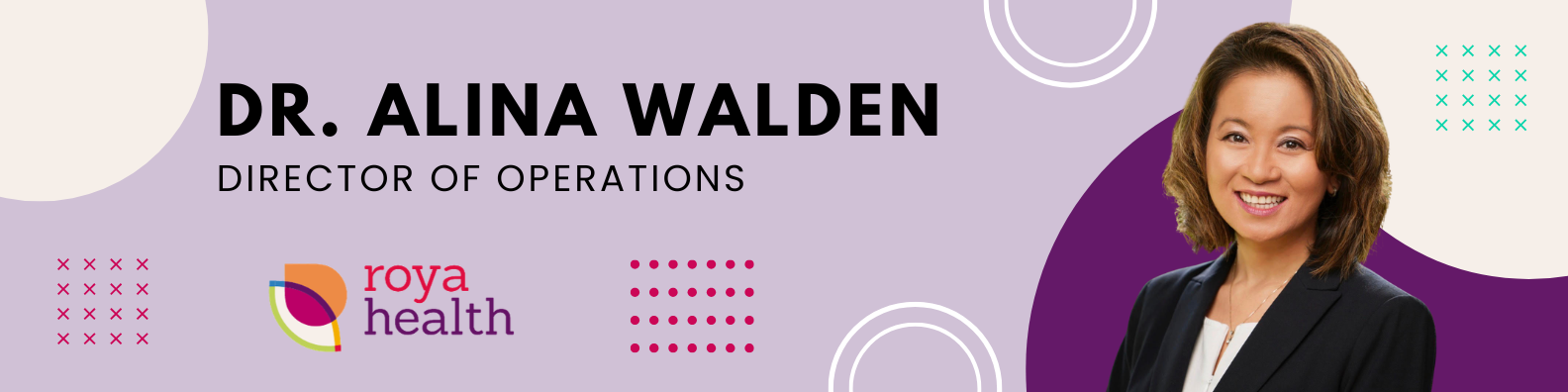
Welcoming Dr. Alina Walden, Director of Operations
Roya Health is proud to welcome Dr. Alina Walden to our leadership team. A seasoned healthcare executive with a passion for whole-person care, Dr. Walden brings the expertise, vision, and drive to help us deliver even better outcomes for the complex populations we serve.
A Career Built on Complex Populations
Dr. Walden has spent her career at the intersection of clinical excellence and operational performance. Her experience spans Medicare, Medicaid, and commercial populations, with a particular focus on high-risk, behavioral health, and medically fragile patients, the exact populations at the heart of Roya Health’s mission.
Most recently, she served as Vice President of Clinical Services at Adobe Population Health, where she led enterprise-wide initiatives in value-based care, utilization management, provider engagement, and CMS risk adjustment strategy. Her track record of improving HEDIS quality performance and STAR measures, while simultaneously driving revenue cycle optimization and compliance, reflects the rare combination of clinical and operational depth she brings to every role.
“Exceptional patient experiences are achieved through engagement, accountability, and partnership across the entire care team.”
DR. ALINA WALDEN, DIRECTOR OF OPERATIONS, ROYA HEALTH
Credentials That Speak to Her Commitment
Dr. Walden earned her medical degree from New York Medical College and her MBA from the University of Phoenix, a combination that reflects her dual command of clinical medicine and business leadership. Her certifications demonstrate an even deeper commitment to excellence:
MD
New York Medical College
MBA
University of Phoenix
CPMA
Certified Professional Medical Auditor
CPCO
Certified Professional Compliance Officer
CPC
Certified Professional Coder
CRC
Certified Risk Adjustment Coder
LSS MBB
Lean Six Sigma Master Black Belt
A Perfect Fit for Roya Health’s Mission
Dr. Walden’s expertise in integrated care delivery, behavioral health integration, and population health management aligns directly with our approach to whole-person care. Her ability to bridge clinical operations, quality improvement, and financial performance gives Roya Health a distinct advantage as we continue scaling programs for complex patient populations.
Her core areas of focus include:
Value-Based Care
Population Health
HEDIS & STAR Measures
CMS Risk Adjustment
Behavioral Health Integration
Quality Improvement
Utilization Management
Revenue Cycle Optimization
Integrated Care Delivery
Healthcare Compliance
Beyond her professional accomplishments, Dr. Walden is a collaborative leader who believes patient-centered care is built on trust and accountability, values that run through everything we do at Roya Health. Outside of work, she enjoys reading, hiking, and spending time with her husband and children.
We are excited about what lies ahead. Please join us in welcoming Dr. Alina Walden to the Roya Health family.

Dr. Shar Najafi-Piper, PhD | The Doctor Who Became a CEO featured on Pain Doctor
What happens when a psychologist decides one patient at a time just isn't enough? In this episode of Doctors Unscripted, CEO Dr. Justin Thompson sits down with Dr. Shar Najafi-Piper, CEO of Roya Health, to explore what it really looks like when clinical expertise meets entrepreneurship, and what that means for the future of children's behavioral health.
In May, our CEO Dr. Shar Najafi-Piper, PhD was invited to be a guest on the Pain Doctor podcast.
On this podcast they discuss, what happens when a psychologist decides one patient at a time just isn't enough? In this episode of Doctors Unscripted, CEO Dr. Justin Thompson sits down with Dr. Shar Najafi-Piper, CEO of Roya Health, to explore what it really looks like when clinical expertise meets entrepreneurship and what that means for the future of children's behavioral health. From her unexpected path into psychology to building one of Arizona's most innovative pediatric behavioral health companies, Dr. Najafi brings a perspective that is equal parts clinician and CEO.
They also dive into: Why kids with complex care needs are falling through the cracks The real relationship between chronic pain and mental health What entrepreneurs get wrong about burnout and work life balance How to navigate the healthcare system if your child needs behavioral health support The mindset shift every leader needs to sustain long term success This conversation is for anyone in healthcare, entrepreneurship, or anyone who has ever wondered if the system is actually built to help people.

I spent fifteen years watching the system fail the same kids. So I built something different.
By Dr. Shar Najafi-Piper, PsyD | CEO & Founder, Roya Health
She was 7 years old and had already seen 4 providers.
Her pediatrician had flagged behavioral concerns at her five-year well visit. A therapist was brought in. Then a developmental specialist. Then, a second pediatrician was consulted for a second opinion on the recurring stomach pain nobody could explain. Four providers across three different practices, none of whom had ever spoken to each other. The mother kept a three-ring binder. She brought it to every appointment and laid it open on the exam table like an offering, here, this is everything, please help us figure out what is happening to my daughter.
Maybe this sounds familiar. Your child has been seen by a pediatrician, a therapist, a specialist, and still nobody seems to have the full picture. You are the one keeping track of everything, carrying notes from one appointment to the next, repeating the same history to every new provider. You are doing everything right, and somehow the pieces still are not connecting.
That is the experience that led me to build Roya Health.
What I was watching was not a failure of individual providers. Every clinician in that child's care was competent and trying. The problem was structural. When a child has anxiety that manifests as stomachaches, the gastroenterologist treats the gut and refers to behavioral health. Behavioral health treats anxiety and refers back if symptoms persist. The pediatrician manages the middle and tries to hold the thread. Each provider does their piece. Nobody owns the whole picture. And the family, the mother with the binder, becomes the connective tissue between all of it. A role she was never trained for and never asked to take on.
This is not a rare edge case. It is how most of behavioral healthcare for children is structured in this country. Parallel tracks that run near each other but do not touch.
What happens in that gap? Kids wait. Families get exhausted. Symptoms that were manageable at seven become entrenched at twelve. The stomach pain becomes school avoidance. The anxiety becomes something harder to treat. By the time a family finds their way to integrated care, if they find it at all, there is often more to undo.
I spent years working inside systems I could not change. I adjusted my approach, pushed harder for communication across care teams, called pediatricians directly, and sent longer notes than anyone asked for. It helped at the margins. The structure remained.
Roya Health started from a simple question: what if the structure itself were different?
Not a referral network. Not a warm handoff. An actual integrated practice in which the psychologist, psychiatric provider, and medical team are in the same building, working from the same clinical picture and making decisions together. Where a parent does not have to be the one carrying information between providers who have never met.
The model we built is not complicated. It is just not how most outpatient behavioral health is set up, because building it requires solving problems that are easier to avoid. Shared documentation. Coordinated scheduling. Clinical team meetings that happen regularly and actually change care plans. Billing structures that support collaboration rather than penalize it. None of this is revolutionary. All of it takes work to maintain.
What it produces, in practice: the seven-year-old with anxiety and stomach pain sees a psychologist and a medical provider in the same visit. They leave with one plan, not two parallel ones. The mother does not need the binder, because our team already has the information.
I want to be honest about what we are still figuring out. Roya Health operates across three locations in Arizona and is growing. Growth creates the same coordination pressures we were designed to solve. The larger we get, the more intentional we have to be about not drifting back toward the fragmented model that is easier to scale. That tension is real, and I think about it often.
What I no longer think about is whether integration is worth the effort. I have seen what it changes.
The families who come to us often arrive depleted. They have been through the referral circuit. They are braced for another partial solution. The shift that happens when they realize our team has already talked, that the psychologist and the prescriber and the pediatric provider have a shared picture of their child, is not dramatic. It is quiet. A kind of relief that has been building for a long time.
That is what we built Roya for. Not the idea of integration, which is easy to put in a mission statement. The experience of it on an ordinary Tuesday for a family that has been carrying a binder for two years.
We have a long way still to go. But we know what we are building toward.
_________________________________
Dr. Shar Najafi-Piper, PhD is the founder and CEO of Roya Health, an integrated behavioral health practice serving children and families in the Greater Phoenix area.