

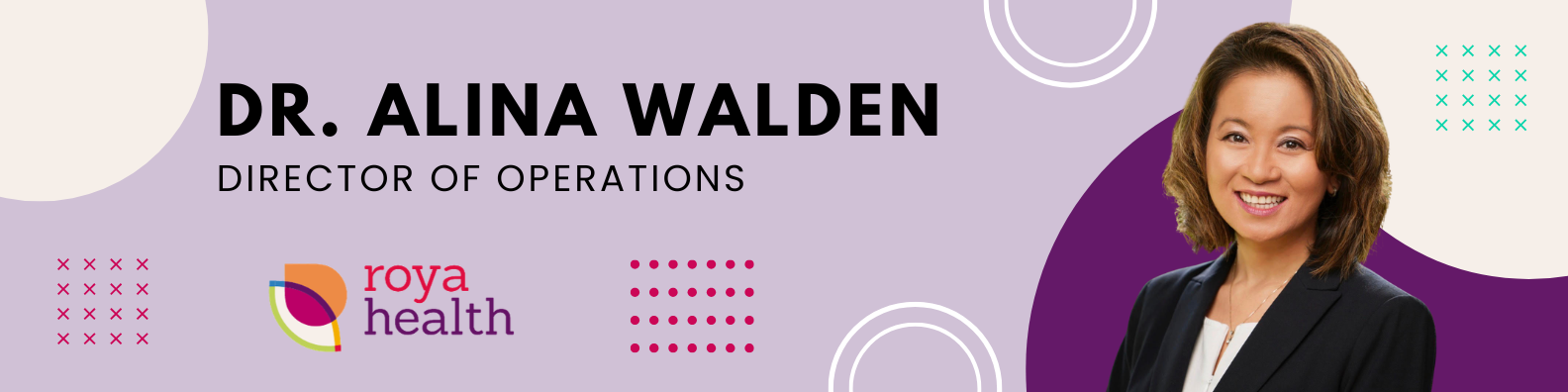
Welcoming Dr. Alina Walden, Director of Operations
Roya Health is proud to welcome Dr. Alina Walden to our leadership team. A seasoned healthcare executive with a passion for whole-person care, Dr. Walden brings the expertise, vision, and drive to help us deliver even better outcomes for the complex populations we serve.
A Career Built on Complex Populations
Dr. Walden has spent her career at the intersection of clinical excellence and operational performance. Her experience spans Medicare, Medicaid, and commercial populations, with a particular focus on high-risk, behavioral health, and medically fragile patients, the exact populations at the heart of Roya Health’s mission.
Most recently, she served as Vice President of Clinical Services at Adobe Population Health, where she led enterprise-wide initiatives in value-based care, utilization management, provider engagement, and CMS risk adjustment strategy. Her track record of improving HEDIS quality performance and STAR measures, while simultaneously driving revenue cycle optimization and compliance, reflects the rare combination of clinical and operational depth she brings to every role.
“Exceptional patient experiences are achieved through engagement, accountability, and partnership across the entire care team.”
DR. ALINA WALDEN, DIRECTOR OF OPERATIONS, ROYA HEALTH
Credentials That Speak to Her Commitment
Dr. Walden earned her medical degree from New York Medical College and her MBA from the University of Phoenix, a combination that reflects her dual command of clinical medicine and business leadership. Her certifications demonstrate an even deeper commitment to excellence:
MD
New York Medical College
MBA
University of Phoenix
CPMA
Certified Professional Medical Auditor
CPCO
Certified Professional Compliance Officer
CPC
Certified Professional Coder
CRC
Certified Risk Adjustment Coder
LSS MBB
Lean Six Sigma Master Black Belt
A Perfect Fit for Roya Health’s Mission
Dr. Walden’s expertise in integrated care delivery, behavioral health integration, and population health management aligns directly with our approach to whole-person care. Her ability to bridge clinical operations, quality improvement, and financial performance gives Roya Health a distinct advantage as we continue scaling programs for complex patient populations.
Her core areas of focus include:
Value-Based Care
Population Health
HEDIS & STAR Measures
CMS Risk Adjustment
Behavioral Health Integration
Quality Improvement
Utilization Management
Revenue Cycle Optimization
Integrated Care Delivery
Healthcare Compliance
Beyond her professional accomplishments, Dr. Walden is a collaborative leader who believes patient-centered care is built on trust and accountability, values that run through everything we do at Roya Health. Outside of work, she enjoys reading, hiking, and spending time with her husband and children.
We are excited about what lies ahead. Please join us in welcoming Dr. Alina Walden to the Roya Health family.

What We Look for When We Hire a Clinician, and Why It Has Nothing to Do With Their CV.
By Dr. Shar Najafi-Piper, PhD | CEO & Founder, Roya Health
The CV tells us someone can do the job. It does not tell us whether they will be good at it here, with these families, in this kind of practice.
We look at licensure. We look at experience with children and adolescents. Those are the entry requirements, not the hiring criteria. By the time a licensed clinician, licensed clinical social worker, or licensed professional counselor is sitting across from us, we already know they are qualified on paper. What we are actually trying to figure out is something harder to name and a lot more important.
We hire for curiosity first
The clinicians who do the best work at Roya Health are the ones who remain genuinely curious about why a child presents the way they do. Not pattern-matching to a diagnosis and moving forward, but sitting with the question. Wondering. Wanting to understand the family system, the school context, and the history that arrived before this child ever walked through our door.
You can hear curiosity in an interview. When we ask someone to walk us through a complex case, the clinicians we want to hire slow down at the complicated parts. They do not rush to a resolution. They linger where things were unclear, where they had to revise their thinking, where they were not sure. That quality, the willingness to stay in the not-knowing, is what we are listening for.
A rehearsed answer moves fast. It has a clean arc: here was the problem, here is what we did, here is how it resolved. A real answer has more texture. There is usually a moment where the clinician says something like, "and honestly, I still think about that case," or "I am not sure we got that one right." Those moments tell us a lot.
Tolerance for ambiguity is non-negotiable
Outpatient behavioral health care with children and families is not a clean discipline. A child comes in presenting with anxiety, and six sessions in, you are also looking at a parent who is undiagnosed and unaware of it, a school environment making everything worse, and a sibling dynamic nobody mentioned at intake. The picture keeps shifting. The treatment plan has to shift with it.
Clinicians who need certainty early and get uncomfortable when a case does not quickly resolve into a clear clinical framework struggle in this work. Not because they are not skilled, but because the work itself does not accommodate that need. We surface this in the interview by asking about the messiest case someone has held. Not the hardest. The messiest. The one where nothing lined up neatly.
The clinicians we hire can describe that case with something close to equanimity. There is always care there, but also a grounded acceptance that complexity is the job, not the exception.
How someone talks about their hardest moments matters more than what they say
We ask everyone some version of this question: tell us about a time when the work was really hard. What made it hard, and how did you carry it?
We are not looking for a specific answer. We are looking for self-awareness, and for evidence that someone has actually reflected on the experience rather than filed it away. Clinicians who can talk about difficulty without either dramatizing it or minimizing it, who can name the cases that stayed with them, are the ones who tend to take care of themselves well enough to stay in this field long-term.
Burnout among mental health professionals in Arizona is real and well-documented. It is a workforce issue, yes, and a culture issue as well. We try to hire people who already have some relationship with their own limits, because that is the foundation on which everything else is built. A clinician who cannot hold their own experience is not going to be able to hold someone else's, not sustainably.
What integrated care means for the people doing it
Roya Health operates as an integrated behavioral health practice, meaning our clinicians never work in isolation. Therapists, prescribers, and care coordinators work from a shared picture of each family. That model was built for families, and it turns out it is also better for the clinicians inside it.
Working in a team reduces the professional isolation that accelerates burnout. Clinical supervision is built in, not bolted on. When a case is complicated, there is a room full of people who know the family and can think through it together. That is not how most behavioral health jobs in Phoenix are structured. It is how we have chosen to build ours.
What we are really building
When we bring someone onto the Roya team, we are not filling a slot. We are adding someone to a care community that families in the greater Phoenix, AZ area trust, often at the hardest points in their lives. That responsibility shapes everything about how we hire.
The CV gets someone in the room. What happens in the room is where the real conversation starts.
Dr. Shar Najafi-Piper is the founder and CEO of Roya Health, an integrated behavioral health practice serving children and families across the greater Phoenix, AZ area. Learn more at roya.health.